Building a Multi-Entity Financial Data Hub Inside a Regulated Bank

A Tier-1 financial institution needed general ledger data from multiple legal entities consolidated into a single, governed analytics platform — without loosening a single control.

At a glance

ClientTier-1 financial institution
IndustryBanking and financial services
PlatformSnowflake, with Azure SQL source systems
EngagementMulti-phase
StatusPhase 1 deployed to production; Phase 2 in design

The challenge

Finance teams at multi-entity organizations spend the first week of every month answering the same question: do these numbers agree?

Our client’s general ledger data lived in operational systems built for transaction processing, not analysis. Consolidating across legal entities meant manual reconciliation, spreadsheet-based assembly, and a month-end close where the analysis could not start until the data wrangling finished.

They did not need a faster report. They needed a governed layer between the ledger and the analyst — one the finance organization could trust without re-deriving every figure by hand.

The constraint that shaped everything

This is the part most data modernization stories leave out.

The work happened inside a regulated bank. That meant a formal vendor security review before a single production credential was issued. It meant every change moving through a documented change-request process with test evidence and independent approval. It meant no customer records and no personally identifiable information were ever available to us during the build.

Most consultancies treat that period as dead time and bill for waiting. We didn’t.

While the security review ran, we built and validated the entire migration approach in an isolated lab environment using only technical metadata and synthetic data. When final clearance came through, we weren’t starting. We were deploying something already proven.

That decision is the single reason this project delivered on the timeline it did — roughly a 50% reduction in development cycle time.

What we built

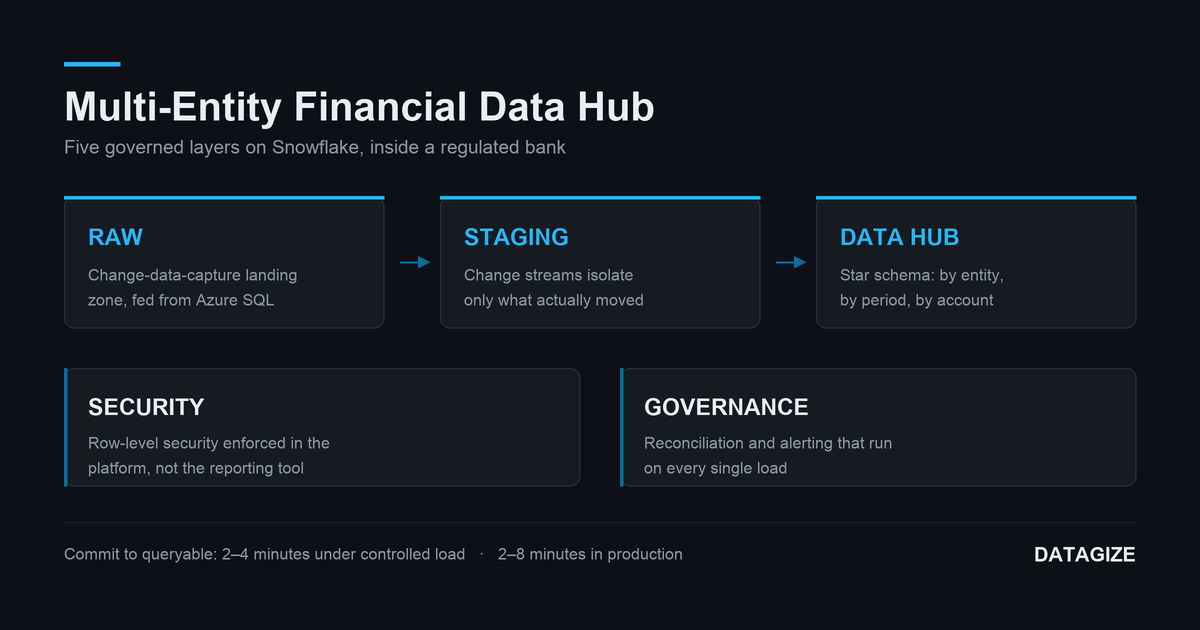
A layered Snowflake data hub — five distinct schemas, each with one job, each a real deployment and permissions boundary:

  • Raw — change-data-capture landing zone, fed continuously from the client’s Azure SQL source systems via enterprise replication tooling.
  • Staging — change streams that isolate what actually moved since the last run, so downstream processing handles deltas rather than reprocessing history. The pipeline runs as micro-batches: a ledger change posted in the source systems reaches the hub in two to four minutes under controlled load testing, and two to eight minutes in production.
  • Data hub — the consumption layer. A dimensional star schema modeled around how finance actually asks questions: by entity, by period, by account.
  • Security — row-level security enforced in the platform itself, not bolted onto a reporting tool. Entity-level data separation is a property of the data, not a setting someone can forget.
  • Governance — automated validation and alerting. Independent checks reconcile the hub against source counts and balances on every load and raise an alert when they disagree.

That last layer is the one we’d argue matters most. Reconciliation isn’t a project phase that ends. It’s a standing control that runs on every load, forever.

The platform runs to more than 250 managed database objects. Finance users reach it through governed reporting; the operations team monitors load health through a dashboard running natively inside Snowflake.

The part that isn’t the pipeline

The data pipeline is the plumbing. The hard problem was accounting.

Getting general ledger data into a warehouse is a solved problem. Modeling it so that entity consolidation, period logic, and account hierarchies behave the way a controller expects — that requires someone who understands the ledger, not just the loader.

Every design decision in the star schema traces back to a mechanic of how the business actually closes its books. That domain fluency is what separated this engagement from a generic lift-and-shift, and it’s what we’d tell any finance organization to screen for before hiring a data partner.

How we worked

We put the schema under version control. The platform arrived as a sequence of hand-maintained deployment scripts, versioned by filename, with no history between versions. We migrated the entire schema into a proper repository — one file per database object, generated deployment scripts, and automated drift detection that compares what’s actually running against what’s supposed to be. Nobody has to remember what changed. The system can prove it.

We built for the bank’s process, not around it. Change requests ship with generated implementation plans and test-evidence workbooks. Approval gates are part of the delivery pipeline, not friction applied to it.

We used Gen AI where it was safe and useful. Accelerating schema migration and validation work in an isolated environment — never on customer data, never as a substitute for review. We wrote about that approach in The Long Game.

Results

  • Phase 1 in production, serving governed general ledger analytics across multiple legal entities.
  • Automated reconciliation running on every load, replacing manual spot-checks with standing controls.
  • Full deployment traceability — every object versioned, every change attributable, drift detectable automatically.
  • A finance team that starts the month analyzing instead of assembling.

What’s next

Phase 2 is underway: additional operational reporting, and a design engagement to map financial reporting onto the hub.

Is your month-end close a data problem?

If your finance organization is reconciling entities by hand, or your analysts spend the first week of the month assembling data instead of interpreting it, that’s an architecture problem — and it’s fixable.

Architecting a Financial Data Hub for Multi-Entity Consolidation

Update, August 2026: Phase 1 is now in production. Read the full case study.

The Real Bottleneck in Financial Analytics

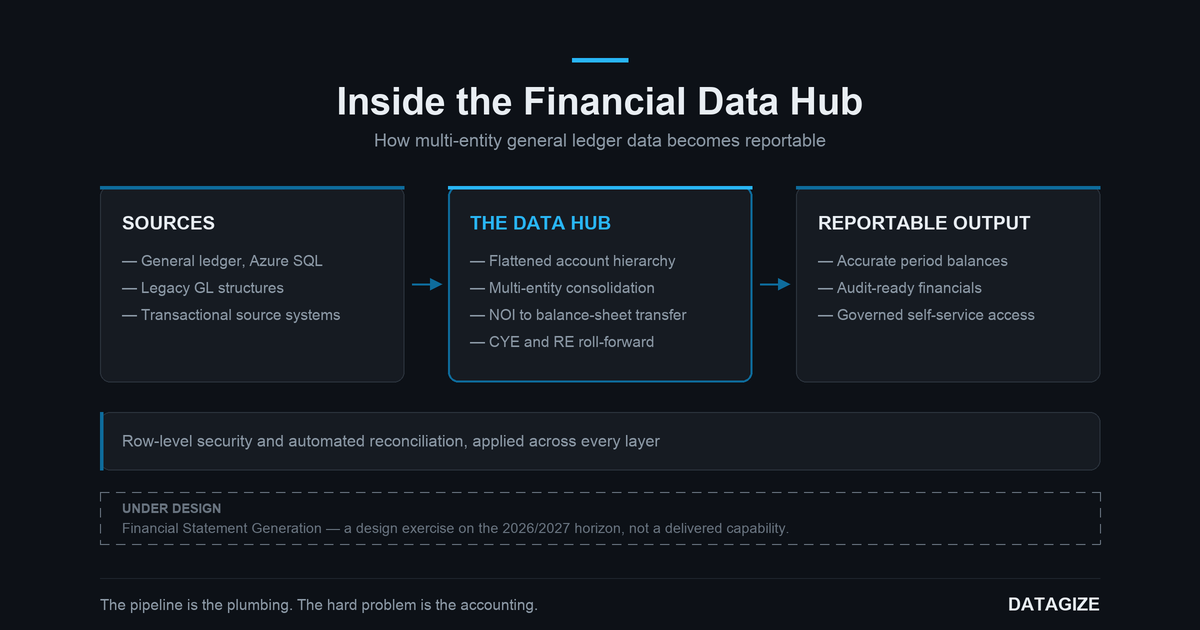
We are currently 60 days into a complex enterprise data modernization project, successfully streaming core transactional data into a modern cloud warehouse. But as any seasoned finance professional knows, the data pipeline is just the plumbing. The true bottleneck in modernizing financial analytics is the business logic—specifically, taming the General Ledger.

Most modern data migrations fail because standard data engineers don’t understand the mechanical complexity of accounting. They build tables, but they don’t know how to handle the shifting idiosyncrasies of period balances.

Solving Accounting Complexity at the Database Level

At Datagize, we approach this differently. Drawing on 40+ years of enterprise data engineering and a deep MBA/Accounting foundation, our current milestone involves building out a Financial Data Hub that programmatically solves the most painful aspects of the month-end close.

We do this by flattening the complex account hierarchy directly within the data model. This architectural decision abstracts the heavy logic away from the BI layer and automates the workflows that usually trap finance teams in Excel, including:

  • Seamlessly handling the consolidation of books across multiple entities.
  • Dynamically calculating roll-forwards for Current Year Earnings (CYE) and Retained Earnings (RE).
  • Automating the shift of Net Operating Income (NOI) from the P&L to the Balance Sheet.

Governance: Built-In, Not Bolted On

In financial services, accuracy is only half the battle; security is the other. Our architecture handles strict authentication and native row-level security. Data is restricted strictly on a “need-to-know” basis, ensuring segment leaders only see their approved domains, while secure external data sharing capabilities allow for frictionless, governed output for auditors or board reporting.

The Roadmap: Looking Ahead to Financial Statement Generation (FSG)

With the core Data Hub and consolidation logic deployed, the next question we are working through is what fully integrated Financial Statement Generation (FSG) would look like natively within this architecture. That is a design exercise on the 2026/2027 horizon, and we will write about what we learn from it.

Ready to Transform Your Financial Analytics?

You don’t just need data engineers to move your financial data; you need architects who understand what a balance sheet actually is. If your organization is ready to stop fighting its account hierarchy and modernize its month-end close without compromising financial integrity, let’s talk.

The Long Game: Why We Went Dark (And Why We’re Ready to Sprint)

Update, August 2026: Phase 1 is now in production, and the first Trench Tale from this deployment is published. Read the full case study.

If you’ve followed Datagize, you might have noticed we’ve been quiet for the last eight months. No new blog posts, no LinkedIn hot takes.

That silence wasn’t a vacation. It was focus.

For the better part of 2025, we have been in the trenches with a Tier-1 financial services leader, preparing for a major modernization of their critical data infrastructure.

The Enterprise Reality: Security First Anyone who works in Fintech or Banking knows that digital transformation requires more than just code. It requires deep alignment with rigorous security standards, from InfoSec clearances to comprehensive risk assessments.

This process is designed to be deliberate. But for many development teams, this necessary planning phase often results in “dead time.”

The “Shadow Build”: Validating 50% Faster Delivery We took a different approach. While we worked through the necessary compliance and architectural gates, we didn’t sit idle. We used that time to replicate the target architecture in our own secure Datagize environment.

We built out the Snowflake constructs, tested our data models, and refined our Gen AI migration workflows against the complex backlog challenges we knew were coming.

The result? We haven’t just signed a contract; we have validated a roadmap that cuts the typical development cycle by 50%.

Security Note: The “Metadata-Only” Approach We know that speed cannot come at the cost of security. That is why our Gen AI workflows are strictly limited to structural design and engineering. We use these tools to generate Snowflake schemas and stored procedures based on technical metadata (DDL) and synthetic data in our isolated lab. No customer records, PII, or financial data are ever exposed to these models. We bring the validated architecture to the client site, not the AI bot.

Moving from Strategy to Execution We recently received the final green light—badged, connected, and approved.

Because we spent the planning phase building and testing our accelerators internally, we aren’t starting from zero. We are starting with a validated engine. We aren’t guessing if our Near-Real-Time Data Hub approach works—we’ve already seen it run in our lab.

What’s Next? We are now moving into the deployment phase. Over the coming months, we will be sharing “Trench Tales” from this deployment (anonymized, of course) to show what it looks like to move fast in a highly regulated environment.

We’re back, we’re compliant, and we’re ready to build.

Before You Build: Start with Discovery

“We’re deciding between Snowflake and Databricks — can you help us design the right architecture?”

That’s how a lot of our first calls begin. Prospects want to talk tech: lakehouse vs. warehouse, dbt vs. Informatica, Power BI vs. Looker. But the moment we ask about business needs, data trust, or source system readiness, the picture changes.

One client told us they’d already captured all their business requirements and wanted to start with design. Weeks later, we were running multi-day working sessions with users across geographies just to gather the foundational use cases that had been missed.

We spent more time on requirements and data profiling in that project than almost any other — and because we did, it succeeded.

Here’s the reality:

The first 15–20% of a data project determines whether it will succeed — with 100% accuracy.

Do discovery right? You deliver on-time, on-budget, with something that solves the real problem and gets adopted.

Skip it? You will fail. Guaranteed.


Discovery Is More Than Requirements

It’s about aligning business needs to the right technical solutions — grounded in a clear-eyed understanding of your organization’s data, culture, and constraints.

That’s why every Datagize engagement begins with our Discovery & Data Health Framework:

PhaseFocusKey Deliverables
1. Business ContextWhat decisions are we supporting?Use case inventory, success metrics
2. Data Profiling & QualityCan we trust the data? Where are the gaps?Data quality assessment, profiling summary
3. Governance & OwnershipWho owns what? Is there clarity and stewardship?RACI matrix, data domain model, lineage maps
4. Security & PrivacyAre we compliant and protected?Access controls, classification strategy
5. Metadata & LineageCan users trace what they’re seeing?Glossary, transformation lineage, semantic mapping
6. Architecture FitWhat will work in your environment?Stack recommendations aligned to your org’s maturity
7. Organizational ReadinessDo we have the skills and buy-in to succeed?Capability gap analysis, enablement roadmap
8. PrioritizationWhat should we build first, and why?Feasibility vs. value scoring, roadmap
9. MVP DesignHow do we learn fast before scaling?Prototype or working PoC with feedback loop

Tools Don’t Deliver Value. Clarity Does.

Architectural decisions — whether it’s Snowflake, Databricks, BigQuery, or Synapse — should come after you’ve clarified the problem you’re solving.

Too many teams burn time and budget chasing trends instead of solving the problems that matter.

With a strong discovery foundation, the right architecture emerges naturally.


Let’s Talk Before You Build

If you’re planning a data transformation, Datagize can help you lay the groundwork for success — and avoid the rework and regret that come from skipping discovery.

Schedule a discovery session

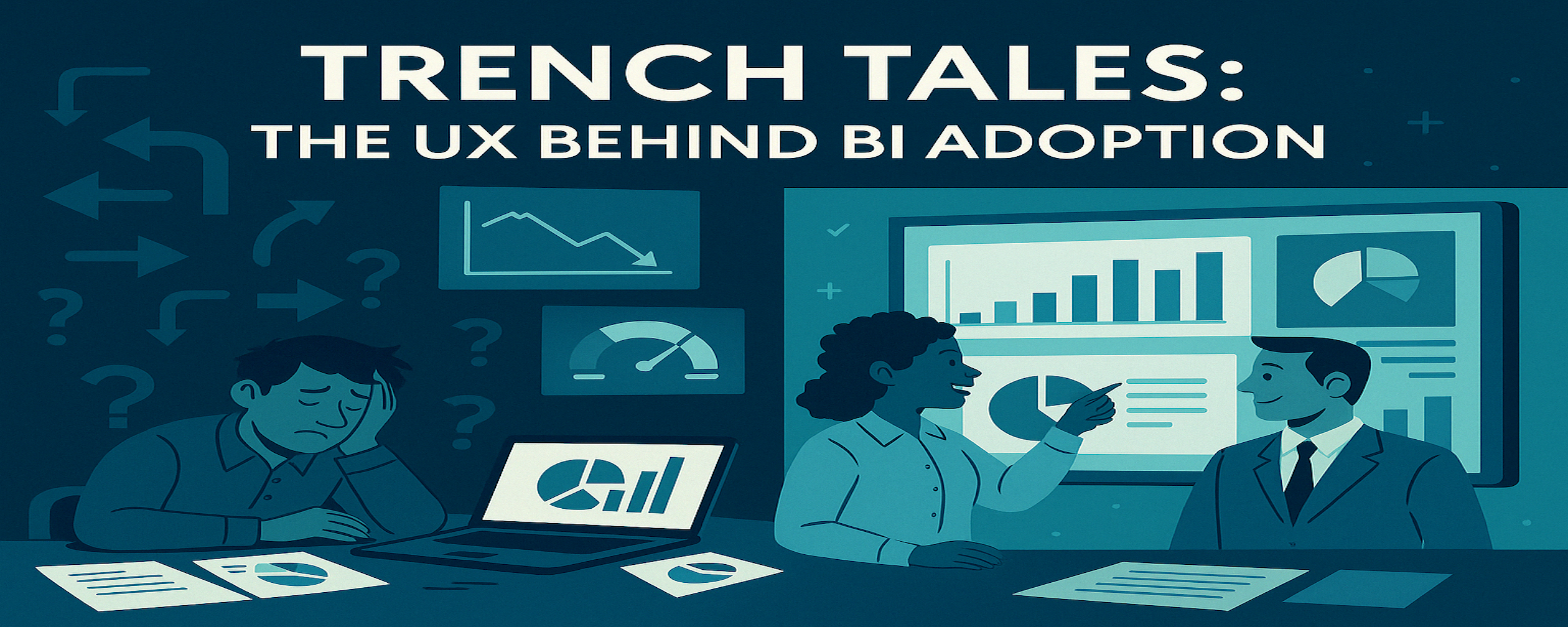
Trench Tale #4 : The UX Behind BI Adoption

Modern BI tools promise a lot — faster insights, cleaner visuals, empowered users.

But here’s the truth from the trenches:

BI adoption fails when tools come before trust.

We’ve helped organizations untangle BI rollouts that looked good on paper but missed the mark in practice. And time after time, it wasn’t the tool’s fault. It was the approach.


When BI Modernization Stalls

At one State Fund, Tableau had been chosen as the flagship BI tool. On the surface, it made sense: sleek dashboards, interactive visuals, and wide industry adoption.

But within weeks, adoption began to slow. Reports that had been workhorses for years were suddenly out of reach — or worse, rebuilt in ways that didn’t serve the business.

Two examples stood out:

  • Contingent Commission: A regulatory report with complex conditional formatting, pixel-perfect layout, and business rule-based rendering. Tableau struggled to deliver both the structure and export fidelity required for compliance.
  • Agency Current Book: A report built with page sets, custom summary rows, and advanced crosstab logic — again, poorly suited to Tableau’s flat design model.

And then there was the OCR (Open Claims Review) — a report designed for live meetings with outside agents.

For OCR, the business needed to override data values temporarily, reflecting last-minute changes that wouldn’t hit the source system for up to an hour. This meant:

  • Users could write back changes in the source system.
  • The DW received a near-real-time push of just this data item.
  • Cognos picked it up immediately, ensuring the report reflected real-time adjustments.

Tableau, by contrast, required a full refresh to pick up those changes — not viable for these time-sensitive meetings.


From Feature List to Data Wishlist

We shifted the conversation from features to needs.

We led the team through a data wishlist process:

  • What absolutely needed to stay?
  • What could evolve?
  • What was worth building new?

With that in hand, we ran a gap analysis and helped architect a hybrid BI environment:

  • Cognos handled high-complexity reports, real-time overrides, and print-perfect outputs.
  • Tableau supported exploratory dashboards and visual summaries where its strengths shone.

It wasn’t about holding onto the past. It was about preserving trust — and designing BI around how people worked, not just how the tool was sold.


BI Migration Pitfalls We See Again and Again:

  1. Tool-first thinking: Choosing a platform before understanding user needs.
  2. Feature-for-feature rebuilds: Replicating old reports exactly, even if they weren’t ideal to begin with.
  3. Ignoring data flow realities: Real-time needs vs. batch refresh capabilities.
  4. One-size-fits-all UX: Assuming executives and analysts want the same thing.

Successful BI isn’t about adopting what’s next — it’s about elevating what works and building for what’s possible.


Lessons in UX from the Field

Across industries, we’ve seen the same patterns:

  • At a regional public university system, HR dashboards were redesigned around what leaders did with the data — not just how they wanted it to look.
  • At a global retail group, dashboards were tailored for regional exploration and executive summaries, respecting different users’ needs.
  • At a behavioral health provider, manual Excel processes were automated and brought back into the BI platform, improving time to insight.

Our UX Framework for BI Adoption

We’ve distilled years of experience into a simple model for BI success:


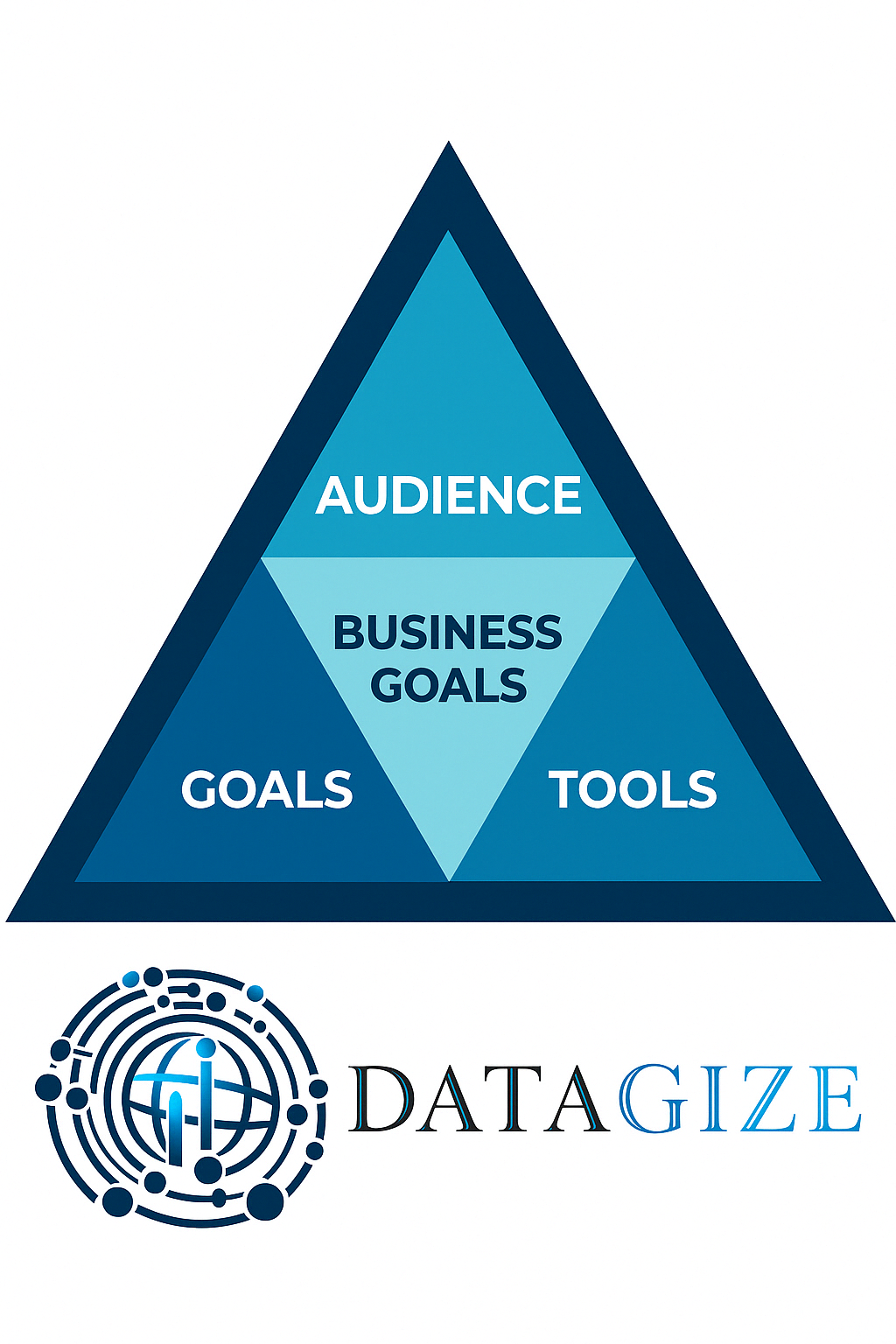
Datagize UX Triangle


  • Audience: Who is using the data? What do they need to know quickly?
  • Purpose: What action does this report drive? Storytelling or exploration?
  • Tool: Which platform supports this best — structurally and visually?

UX Drives Trust. Trust Drives Adoption.

The best BI projects don’t start with tools — they start with users.

If your dashboards aren’t landing, or your adoption is stalling, it’s time to step back. Rethink who you’re designing for, not just what you’re building.


A Personal Note from the Trenches

When I first started building BI solutions in the ‘90s, it was all about getting the reports out — making sure leadership had what they asked for.

But I learned quickly: unless the people on the ground trust the data and know how to use it, none of it matters.

Over the years, I’ve built systems for sales, supply chain, finance, marketing, manufacturing, claims, and more. The tools have changed — but the challenge hasn’t.

BI adoption isn’t a tech problem. It’s a UX problem.

And that’s where we come in.


Ready to Rethink Your BI UX?

If you’re about to choose a tool, or already mid-migration, take a step back.

We’re offering a limited number of free 60-minute BI Trust & UX Fit consults this month.
Let’s talk about how UX could save you months — and rebuild trust before it’s lost.

📩 Drop us a note

You bring the road.
We’ll bring the steering wheel.

Trench Tale #3: What Really Makes Data Governance Stick

At a recent AASCIF Data Track Zoom session, I had the opportunity to co-present with a State Fund colleague on a topic we’ve both lived deeply: how to build data governance that actually works. Not the kind that looks good in policy docs or gets announced at a town hall, but the kind that sticks. The kind that changes the way organizations use, trust, and think about data.

What became immediately clear in the session was this: nearly everyone had tried something related to data governance. And nearly everyone had seen it struggle. It wasn’t for lack of effort, or even executive interest. The issue, as always, was in the execution.

The Illusion of Starting with Tools

Most governance efforts start from the wrong end of the map. Organizations buy a shiny new tool—a data catalog, a quality dashboard, a metadata harvester—and expect it to create structure. But tools reflect structure; they don’t create it.

At Datagize, we anchor governance on three forces: People, Process, and Technology. But what makes that model work is the sequence in which they show up. It starts with principles: clear statements about how your organization believes data should be used, protected, and trusted. Then come the structures—your charter, your roles, your escalation paths. Only after that scaffolding is in place should technology enter the picture.

Skipping this sequence leads to shelfware, not stewardship.

What Actually Worked

In one engagement with a State Fund, we led with principles and purpose. That meant defining beliefs about openness, data risk, and accountability. We then co-created a governance charter and formed a data governance committee composed of business and technical leaders across the organization. The right people were critical—not just role-fillers, but passionate, well-positioned individuals who could influence change.

From there, we prioritized high-impact data domains, focusing first on areas like claims, underwriting, and policyholder services where inconsistencies had real-world consequences. Only once those foundations were in place did we select a data cataloging tool to support the structure we had already built.

The result? Shared definitions. Certified datasets. Self-service reporting. And most importantly, business ownership of data.

Common Pitfalls to Avoid

Governance fails when:

  • IT tries to own it instead of enabling it
  • The organization tries to boil the ocean instead of starting small
  • ROI is assumed, not shown

The big question to ask is: Where is data causing rework, disputes, or decision delays? That’s where governance needs to start.

Also: remember that governance committee members have full-time jobs. Respect their time. Use working sessions to energize documentation and decision-making.

What Made It Stick

What worked in this engagement wasn’t magic. It was:

  • Executive sponsorship
  • Tangible early wins
  • Clear roles and decision rights
  • Cross-functional collaboration
  • Alignment among governance, analytics, and modernization

The client embedded governance into the day-to-day. Jira tickets now include governance metadata. Tableau dashboards are tied to certified datasets. Governance isn’t a side job—it’s part of the workflow.

And trust? That grew because the people using the data were the ones shaping its meaning.

What’s Next

Governance isn’t standing still. AI and automation are pushing data to its limits. Regulators are shifting from trusting policies to requiring proof. Cloud platforms expect you to arrive with a model, not build one on the fly.

Governance must evolve. That means:

  • Investing in maturity, not headcount
  • Integrating DG into analytics and AI planning
  • Embedding governance into the tools people already use
  • Upskilling your people to steward data with confidence

Our Approach

At Datagize, we built the DG Accelerator for organizations that need to move fast. It’s a five-week sprint with structure, working sessions, and real decisions—not just theory. But we also offer a Collaborative Roadmap for those who need to move together, aligning gradually and building buy-in along the way.

Both work. The key is setting the right pace.

Let’s build governance that lasts—not as a checkbox, but as a competitive advantage.


Want to dig deeper? Reach out to start your own Trench Tale.

AI Adoption Without the Hype: Building the Right Roadmap (Part 3 of 3)

Introduction: Avoiding the AI Pitfalls 

The final part of our AI adoption series focuses on how to implement AI strategically. Strategic AI adoption needs to balance innovation with practicality, security, and staffing.

🔹 Part 1: AI Readiness – A Practical Guide for Strategic Adoption

🔹 Part 2: AI in Action – Practical Use Cases for Strategic Adoption

🔹 Part 3 (this post): AI Adoption Without the Hype – Building the Right Roadmap

Cloud vs. On-Prem: Does AI Require the Cloud?

When Cloud is Required: Large-scale AI workloads, federated learning, AI-powered SaaS.

When On-Prem Works Fine: Pre-trained ML models, localized analytics, security-sensitive industries.

AI Security: It’s More Than Just Privacy

🔹 Bias & Fairness – Avoiding discriminatory AI outcomes.

🔹 Model Explainability – Ensuring stakeholders understand AI-driven decisions.

🔹 Adversarial Attacks – Protecting AI from being manipulated.

AI Adoption: Aligning Investments with Business Priorities

Organizations often struggle to decide where to allocate AI resources. The key to successful AI adoption is aligning AI investments with business priorities, rather than chasing trends. A high-impact AI roadmap focuses on:

1️⃣ Quick Wins – Small AI projects that prove value fast (e.g., AI-assisted reporting in finance).

2️⃣ Strategic Growth – Scaling AI where it aligns with long-term business objectives (e.g., predictive analytics for customer behavior).

3️⃣ Risk Management – Implementing AI governance frameworks to manage compliance, ethics, and security risks.

Instead of treating AI as a separate initiative, businesses should integrate AI into their existing analytics and decision-making processes. This approach prevents AI projects from becoming siloed experiments and instead makes them scalable, sustainable drivers of business value.

Building an AI-Ready Workforce

AI adoption is not just about technology—it’s about having the right people and expertise to execute. Companies often struggle with whether to build AI capabilities in-house or rely on external expertise. Key considerations include:

Upskilling Internal Teams – Training analysts and engineers to use AI-driven tools and integrate AI insights into existing workflows.

Hiring AI Specialists – Recruiting data scientists and AI engineers for advanced AI/ML development where needed.

Leveraging Fractional AI Leadership – If an organization lacks a CDO, engaging a fractional CDO can serve as a bridge to develop an AI strategy until full-time leadership is in place.

Partnering with Data Analytics & AI Service Providers – Engaging experts who specialize in data analytics and AI integration ensures that AI-driven insights align with broader business intelligence and decision-making goals.

A hybrid approach — where organizations upskill internal teams while strategically leveraging external expertise — is often the most practical and cost-effective path forward.

From Strategy to Execution: Making AI Work for You

AI adoption isn’t just about technology—it’s about execution. Organizations that succeed don’t just explore AI; they integrate it into their existing analytics, decision-making, and business strategy. Now that you have a roadmap for AI readiness, real-world applications, and strategic adoption, how do you take the next step?

📌 Assess Your AI Maturity – Evaluate where your organization stands and identify gaps in AI readiness, data infrastructure, and analytics capabilities.

📌 Prioritize High-Impact AI Initiatives – Focus on quick wins that deliver measurable value while building a roadmap for long-term AI scalability.

📌 Develop Your AI Talent Strategy – Decide whether to upskill your team, hire AI talent, or leverage external AI & data analytics expertise to bridge skill gaps.

📌 Integrate AI Into Business Strategy – Ensure AI investments align with core business objectives rather than becoming siloed technical projects.

By taking a pragmatic, business-first approach, companies can move beyond the AI hype and achieve real, sustainable value. AI isn’t just about what’s possible—it’s about what’s practical, achievable, and aligned with your business goals.

📌 Read Part 1: AI Readiness – A Practical Guide for Strategic Adoption

📌 Read Part 2: AI in Action – Practical Use Cases for Strategic Adoption

AI in Action: Practical Use Cases for Strategic Adoption (Part 2 of 3)

Introduction: AI/ML Isn’t Just for Tech Giants 

Once the groundwork is set, companies can start leveraging AI — not for futuristic, abstract use cases, but for real business needs. This blog, part 2 of our series, outlines practical AI applications in data analytics across business functions that strategic organizations can start using today. The Maturity Stage framework we are using in the table below was introduced in Part 1 of this series.

🔹 Part 1: AI Readiness – A Practical Guide for Strategic Adoption

🔹 Part 2 (this post): AI in Action – Practical Use Cases for Strategic Adoption

🔹 Part 3: AI Adoption Without the Hype – Building the Right Roadmap

AI/ML Use Cases Across Business Functions

Business FunctionAI/ML Use Case for Data InsightsAI or ML?Maturity Stage
SalesML-driven forecasting models analyze historical pipeline data, seasonality, and external factors (e.g., economic trends) to predict revenue and deal closures.MLRun → Fly
AI evaluates win/loss rates and lead conversion patterns to identify which prospect attributes and sales behaviors drive success.AIRun
FinanceAI detects anomalies in financial transactions, predicts cash flow trends, and identifies cost-saving opportunities by analyzing spending patterns.AI/MLRun → Fly
ML-powered fraud detection models continuously learn from new transactions to spot fraudulent activities before they escalate.MLRun → Fly
Customer ServiceAI performs sentiment analysis on support tickets, call transcripts, and social media to uncover root causes of dissatisfaction.AIWalk → Run
ML predicts customer churn risk based on behavioral patterns and past interactions, helping teams proactively retain at-risk customers.MLRun
HRAI analyzes employee engagement survey responses and HR data to predict turnover risks and retention drivers.AI/MLWalk → Run
AI identifies skills gaps and training effectiveness by analyzing workforce performance data.AIWalk → Run
MarketingAI evaluates campaign performance, customer behavior, and attribution models to determine which channels drive the most conversions.AIRun
ML models predict customer lifetime value (CLV) by analyzing purchase history, engagement, and demographic factors.MLRun
Operations & Supply ChainAI analyzes historical logistics and inventory data to predict demand fluctuations and optimize procurement.AI/MLRun → Fly
ML-powered IoT data analysis detects patterns in equipment sensor data to predict failures and enable predictive maintenance.MLRun → Fly

Applying AI at the Right Time

Implementing AI in business functions isn’t about using the latest technology just for the sake of it. Companies should identify where AI aligns with their strategic goals and ensure that they are applying the right level of AI maturity for their current state. Just as a company wouldn’t implement machine learning models without clean data, they also shouldn’t push AI into areas where traditional analytics would be more effective.

Instead of aiming for full AI automation from day one, organizations should look at AI augmentation — where AI assists decision-makers without completely replacing human expertise. For example, sales teams can start with AI-assisted forecasting before moving to fully automated lead-scoring systems. Finance departments can first leverage fraud detection models to flag anomalies before shifting to AI-driven risk modeling. The key is to let AI enhance human decision-making rather than forcing AI-first strategies prematurely.

Next Steps: Building an AI Roadmap Without the Hype

Understanding what AI can do is only half the battle — implementing it effectively requires a roadmap.

📌 Check out Part 1: AI Readiness – A Practical Guide for Strategic Adoption

📌 Check out Part 3: AI Adoption Without the Hype – Building the Right Roadmap (coming soon)

AI Readiness: A Practical Guide for Strategic Adoption (Part 1 of 3)

Introduction: The AI Hype vs. Reality 

AI is everywhere, but most companies are struggling to move beyond the buzzwords. The truth is, AI is not a magic bullet, and jumping in without a solid data foundation leads to wasted time and money. AI and ML (Machine Learning) are often used interchangeably, but ML refers specifically to algorithms that learn from data patterns to make predictions. This three-part series will guide organizations through a practical, phased approach to AI adoption.

🔹 Part 1 (this post): AI Readiness – A Practical Guide for Strategic Adoption

🔹 Part 2: AI in Action – Practical Use Cases for Strategic Adoption

🔹 Part 3: AI Adoption Without the Hype – Building the Right Roadmap


The Crawl-Walk-Run-Fly Framework for AI Readiness

Many organizations feel pressure to implement AI quickly, fearing they’ll be left behind. However, AI adoption isn’t just about acquiring technology—it’s about ensuring that your organization is operationally and strategically prepared to derive real value from it. Rushing into AI without a strong foundation often leads to poor results, disillusionment, and wasted resources.

Instead of diving headfirst into AI/ML, companies should assess their AI readiness maturity level and take a phased approach:

Stage Focus Area AI/ML Readiness Key Steps
Crawl Data Architecture Health-Check Not Yet Ready for AI Identify & fix bad data structures, eliminate reporting inaccuracies
Walk Descriptive & Diagnostic Analytics Low – AI-Assisted Querying & Summarization ChatGPT-like AI for natural language queries, automated summaries, & data storytelling
Run Predictive Analytics Medium – ML for Forecasting ML for sales forecasting, anomaly detection, & customer segmentation
Fly Prescriptive & Automated Decision-Making High – AI/ML for Prescriptions AI-driven recommendations, process automation, & decision support

Step 1: Conduct a Data Architecture Health Check

Before AI can deliver insights, your data infrastructure must be sound. Many companies think they have a data warehouse — but poor architecture can introduce inaccuracies. A health check should cover:

✅ Data quality & governance – Ensuring accuracy, consistency, and proper governance across data sources.

Schema integrity & best practices – Ensuring star schema designs align with analytics needs, avoiding unnecessary complexity or performance bottlenecks.

Pipeline efficiency & scalability – Evaluating ETL/ELT processes for performance bottlenecks, latency, and future growth.

Measure definition & duplication – Identifying inconsistencies in KPI definitions and removing redundant calculations.

Security & compliance alignment – Ensuring adherence to regulatory standards and implementing proper access controls.

Data integration across silos – Enabling seamless interoperability between systems and reducing data fragmentation.

Step 2: AI Readiness Maturity Assessment

Companies need to evaluate where they stand today to define a roadmap forward:

✔️ Is our data structured & accessible enough for AI-driven insights?

✔️ Do we have the right reporting & analytics foundation?

✔️ What’s the business case for AI—where will it provide the most impact?

Laying the Right Foundation for AI Success

AI implementation is often derailed by a focus on tools rather than strategy. Companies need to shift their mindset from “How do we implement AI?” to “What outcomes do we want AI to drive?” Organizations that succeed in AI adoption start with clear, measurable business objectives before selecting any AI solutions.

For instance, a company struggling with fragmented customer data shouldn’t jump to AI-driven personalization tools before ensuring their data architecture supports accurate, consolidated customer insights. Similarly, a finance team interested in AI-based fraud detection must first establish reliable transaction monitoring systems. AI success starts with foundational improvements—not with cutting-edge algorithms alone.

Next Steps: Moving from Readiness to Real-World Use Cases

Once a company has a strong foundation, it’s time to explore how AI can be applied to real business challenges.

📌 Read Part 2: AI in Action – Practical Use Cases for Strategic Adoption 

📌 Read Part 3: AI Adoption Without the Hype – Building the Right Roadmap (coming soon)

Trench Tale #2: The 48-Hour War Room That Saved a Client

Some consulting wins come from perfect execution. Others come from how you respond when things go wrong.

In consulting, some lessons come easy. Others are forged in high-stakes moments that test your integrity, resilience, and commitment to doing what’s right. Trench Tales is a blog series dedicated to sharing those defining experiences—the moments that shaped us, challenged us, and reinforced the core principles that guide Datagize today.


The year is 2000. The consulting firm I co-founded had built a custom sales commission system for a major client — before any of the big software vendors had even developed their own sales compensation modules. It handled sales territory assignments, overlays, and complex commission formulas. After the client was acquired, we adapted the system for their parent company.

One night, during a critical monthly commission run, something went wrong. The system wasn’t calculating commissions correctly. Time was running out. The client’s leadership was panicked. The executive of sales operations flew in from Canada to oversee the crisis firsthand.

I had just been diagnosed with pneumonia and was at home when the call came in. The IT Director was frantic. The system they had invested so much in was failing at the worst possible time. He wasn’t just asking for help — he was asking for our presence.

So I showed up.

The War Room

As soon as I arrived at the client’s office, I took charge and established a War Room. Within minutes, we had assembled a cross-functional response team — our consultants and client engineers, all focused on one goal: finding the root cause. The stakes were enormous. If we failed, it wouldn’t just damage our reputation — it could cost client executives their jobs.

For 48 hours, we lived in that War Room. We worked in teams, pushing through exhaustion. Some of the brightest minds in the industry were on that office floor, including a PhD software architect who later went on to design a revolutionary virtual keyboard. Yet, despite our collective expertise, the issue eluded us.

Still, we refused to fail.

After 40 straight hours of debugging, log analysis, and relentless testing, our architect spotted something — an anomaly buried deep in the system. A single point of failure. A fixable one.

We patched it. We tested it. It worked.

Just in time to complete the commission run and restore confidence in the system—and in us.

After the dust settled, the client executive pulled me aside. He told me he had never, in all his years professionally, seen a war room run so effectively. The way we coordinated efforts across teams, stayed focused under pressure, and executed with precision left a lasting impression. Our commitment impressed him more than anything technical we may have achieved.

Why This Matters to The Datagize Way

This wasn’t about fixing a system. It was about showing up when it mattered most.

This experience helped shape the ethos of Datagize — where Integrity, Client-Centricity, and Pragmatism aren’t just words. They are how we operate. We take ownership. We stand by our clients. We do whatever it takes to get the job done.

Not every consulting firm would have stayed in that War Room. We did. And that relentless commitment is what defines The Datagize Way.


Want to work with a team that doesn’t back down from challenges? Click one of the buttons below to connect with Datagize.