
The Real Bottleneck in Financial Analytics
We are currently 60 days into a complex enterprise data modernization project, successfully streaming core transactional data into a modern cloud warehouse. But as any seasoned finance professional knows, the data pipeline is just the plumbing. The true bottleneck in modernizing financial analytics is the business logic—specifically, taming the General Ledger.
Most modern data migrations fail because standard data engineers don’t understand the mechanical complexity of accounting. They build tables, but they don’t know how to handle the shifting idiosyncrasies of period balances.
Solving Accounting Complexity at the Database Level
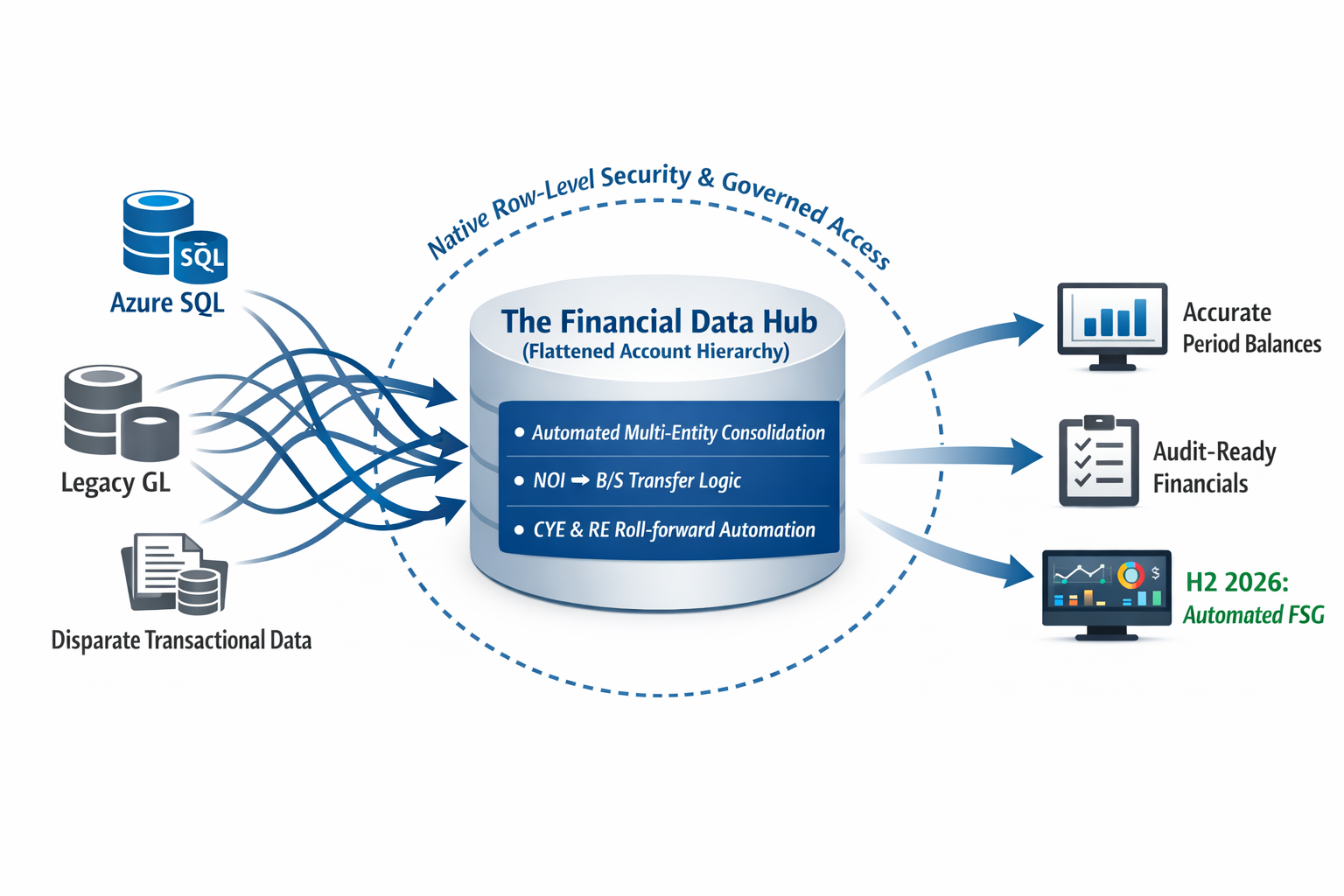
At Datagize, we approach this differently. Drawing on 40+ years of enterprise data engineering and a deep MBA/Accounting foundation, our current milestone involves building out a Financial Data Hub that programmatically solves the most painful aspects of the month-end close.
We do this by flattening the complex account hierarchy directly within the data model. This architectural decision abstracts the heavy logic away from the BI layer and automates the workflows that usually trap finance teams in Excel, including:
- Seamlessly handling the consolidation of books across multiple entities.
- Dynamically calculating roll-forwards for Current Year Earnings (CYE) and Retained Earnings (RE).
- Automating the shift of Net Operating Income (NOI) from the P&L to the Balance Sheet.
Governance: Built-In, Not Bolted On
In financial services, accuracy is only half the battle; security is the other. Our architecture handles strict authentication and native row-level security. Data is restricted strictly on a “need-to-know” basis, ensuring segment leaders only see their approved domains, while secure external data sharing capabilities allow for frictionless, governed output for auditors or board reporting.
The Roadmap: Looking Ahead to Financial Statement Generation (FSG)
With the core Data Hub and consolidation logic deployed, our next major horizon is fully integrated Financial Statement Generation (FSG) natively within the architecture, slated for our 2026/2027 roadmap.
Ready to Transform Your Financial Analytics?
You don’t just need data engineers to move your financial data; you need architects who understand what a balance sheet actually is. If your organization is ready to stop fighting its account hierarchy and modernize its month-end close without compromising financial integrity, let’s talk.